Why Do Couples Keep Having the Same Argument?
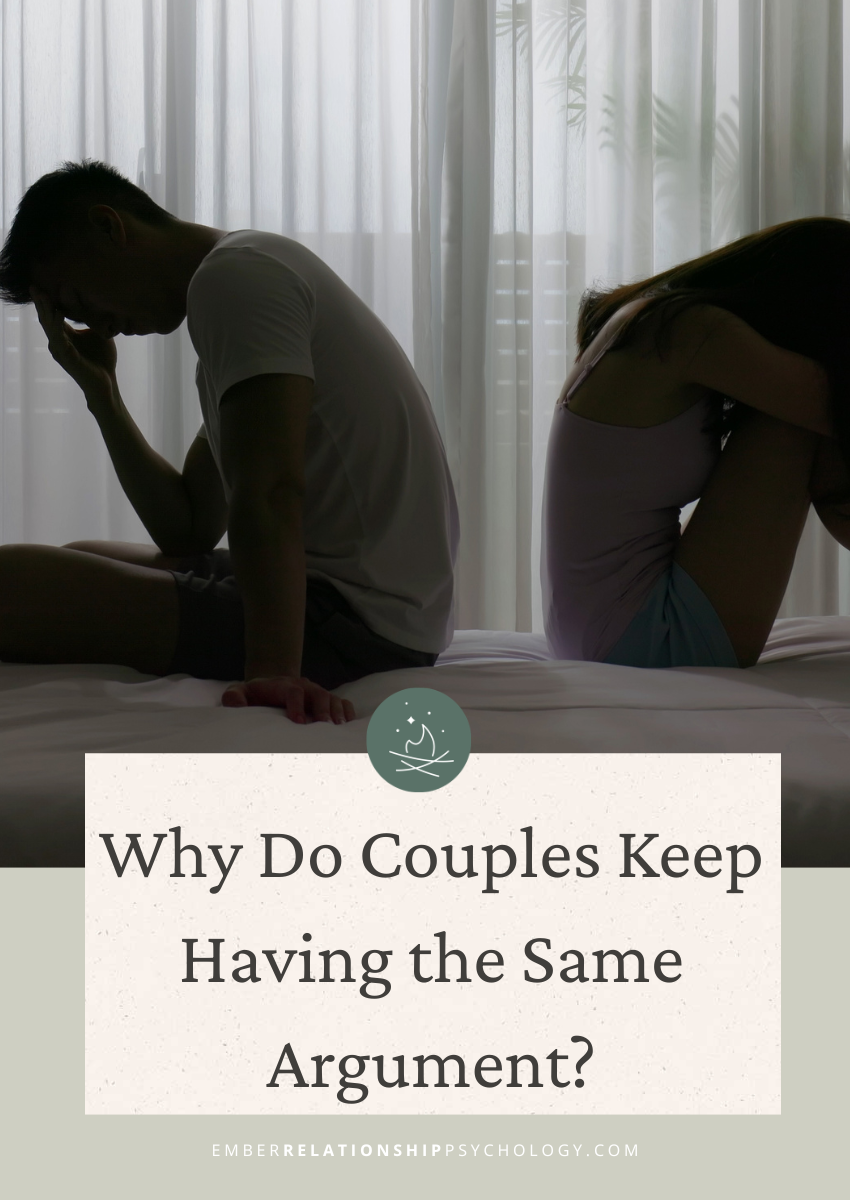
You start talking about the dishes.
Ten minutes later, you're arguing about how one person never feels appreciated, the other feels constantly criticized, and somehow you're bringing up something that happened three years ago.
If you and your partner keep having what feels like the same argument over and over again, you're not alone.
Couples often assume that recurring conflict means something is wrong with their relationship. But many disagreements aren't really about the surface issue at all. Underneath arguments about chores, money, parenting, sex, family, or how you spend your time are often deeper needs, emotions, and differences.
Understanding what is underneath your recurring arguments can change the way you approach them.
Why Do We Keep Having the Same Arguments?
Couples tend to get stuck when they focus on solving the immediate problem without understanding the pattern underneath it.
Imagine one partner says:
"You're always on your phone."
The other responds:
"I'm barely on my phone. You're constantly criticizing me."
The first partner becomes more frustrated:
"You never listen to me."
And the second partner shuts down:
"There's no point talking to you when you're like this."
The argument may appear to be about a phone.
But underneath it, one partner may be saying:
I miss you. I want to feel important to you.
While the other may be saying:
I want to feel accepted rather than constantly feeling like I'm disappointing you.
When couples only argue about the surface issue, those deeper needs remain unresolved.
So the argument returns.
To learn more about couples therapy to help with conflict, click here.
Some Relationship Problems Aren't Meant to Be Solved
One of the most helpful ideas from the Gottman Method is that not every relationship problem has a permanent solution.
Some conflicts are solvable problems. These are usually situational disagreements where couples can find a practical compromise.
For example:
Who is picking up the groceries?
What time should we leave?
How are we dividing bedtime tonight?
Other conflicts are perpetual problems.
These tend to come from lasting differences between partners: personality, preferences, values, lifestyle, emotional needs, family backgrounds, or priorities.
One partner may crave structure while the other values spontaneity.
One may want frequent social plans while the other needs more quiet time.
One may prefer saving money while the other places greater value on experiences.
Neither person necessarily needs to change who they are.
The goal becomes learning how to talk about these differences without allowing them to damage the relationship.
When Conflict Becomes Gridlocked
A perpetual problem becomes much more difficult when couples become gridlocked.
Instead of being able to discuss the difference with curiosity and flexibility, both partners become increasingly entrenched.
You may feel:
"We've talked about this a hundred times."
"They don't understand me."
"Nothing ever changes."
"Why should I compromise when they won't?"
Over time, couples can stop seeing the vulnerable need underneath their partner's position.
They only see the opposition.
The Gottman Method encourages couples to look underneath the conflict and explore the dreams, values, experiences, fears, and needs connected to each person's position.
Often, understanding why something matters creates possibilities that weren't available when the couple was simply arguing about who was right.
How an Argument Starts Matters
Sometimes couples aren't stuck because of what they're discussing.
They're stuck because of how the conversation begins.
If a conversation starts with:
"You never help around here."
the other person is likely to hear criticism.
They may immediately defend themselves:
"That's ridiculous. I do tons around here."
Now the conversation has shifted from solving a problem to proving who is right.
A softer beginning might sound like:
"I've been feeling overwhelmed lately. Could we talk about how we're dividing things at home?"
The concern hasn't disappeared.
But the invitation to respond is very different.
The Gottman Method refers to this as using a softened start-up.
Beginning with your feelings, describing the situation without judgment, and clearly asking for what you need can make it easier for your partner to hear you.
Click here to learn more about how couples therapy can improve the communication in your relationship.
Criticism Can Trigger Defensiveness
Another common cycle occurs when one partner criticizes and the other becomes defensive.
Criticism often sounds like an attack on someone's character:
"You're selfish."
"You never think about anyone but yourself."
"You're so irresponsible."
Defensiveness then attempts to protect against the attack:
"What about everything I do?"
"You're the one who..."
"Nothing is ever good enough for you."
Both people may have legitimate concerns.
But once criticism and defensiveness take over, neither partner feels heard.
One person feels ignored.
The other feels attacked.
And both leave the conversation feeling even more disconnected.
Learning to describe concerns without attacking and learning to take responsibility for even a small part of the problem can interrupt this cycle.
Sometimes One Partner Pursues While the Other Withdraws
Another common pattern happens when one partner wants to resolve conflict immediately while the other needs distance.
The more one partner pushes to talk, the more the other pulls away.
The more the other withdraws, the more urgently the first partner pursues.
Eventually, both partners may believe the other is causing the problem.
The pursuing partner thinks:
"If you would just talk to me, we could fix this."
The withdrawing partner thinks:
"If you would just give me space, I could calm down."
Often, both partners are trying to regulate the same thing, emotional distress, in completely different ways.
Recognizing the cycle allows couples to stop treating each other as the enemy and begin addressing the pattern together.
Your Body Can Make Productive Conflict Almost Impossible
Have you ever been in an argument where you suddenly couldn't think clearly?
Your heart may be racing. You might feel overwhelmed, angry, shaky, or desperate to leave the conversation.
The Gottman Method describes this state as flooding.
When someone becomes physiologically overwhelmed, productive communication becomes much harder.
Continuing the conversation at that point often doesn't solve anything.
Instead, couples may benefit from taking a break long enough for their bodies to settle and agreeing on when they will return to the conversation.
A break isn't the same as abandoning the discussion.
The goal is to return when both people are better able to listen and communicate.
Look for the Pattern, Not the Villain
When couples have been stuck in conflict for a long time, it's easy to begin thinking:
"If my partner would just change, we wouldn't have this problem."
But recurring conflict is often better understood as a cycle between two people.
Something happens.
One person reacts.
Their reaction triggers something in the other person.
That response then intensifies the first person's reaction.
Soon, both partners are doing exactly the things that make the other person feel less safe, less understood, or less connected.
Instead of asking:
Who started this?
it can be more helpful to ask:
What happens between us when we get stuck?
That shift can move couples away from blame and toward understanding.
What Can We Do Differently?
If you keep having the same argument, start by slowing the pattern down.
Ask yourselves:
What are we actually fighting about?
What do I feel when this happens?
What do I need my partner to understand?
What might my partner be trying to communicate underneath their reaction?
Is this a problem we can solve, or a difference we need to learn how to manage?
What happens between us when the conversation starts going badly?
You don't need to eliminate every disagreement to have a strong relationship.
The goal is to develop a different way of navigating the disagreements that inevitably happen.
How Couples Therapy Can Help With Recurring Conflict
Sometimes couples understand their pattern but still struggle to change it.
This is especially common when the conflict has been happening for years. Reactions can become so automatic that couples find themselves repeating the same cycle even when both genuinely want something different.
Couples therapy can help you slow those interactions down, understand what is happening underneath them, and practice new ways of communicating.
At Ember Relationship Psychology, I provide virtual couples therapy across Ontario using the Gottman Method and research-based strategies to help couples improve communication, navigate conflict, repair relationship injuries, and rebuild connection.
As a Certified Gottman Therapist, I help couples move beyond simply deciding who is right and begin understanding what each partner needs to feel heard, valued, and connected.
Learn more about couples therapy for conflict by clicking here.
This blog is not meant to be a substitute for couples therapy or relationship counselling. This should not be construed as specific advice. See a relationship therapist in your area to address your specific problems.